
From prompts to actions: governing AI agents at TRU
Copilot helps people write, summarize, and find information. AI agents go further — they can take actions in our systems on behalf of people. That step changes what responsible use looks like, so we are building TRU’s AI agent governance — a program that stands on its own and works alongside Safe Start.
What changes with agents?
A Copilot prompt produces a draft that a person reviews before anything happens. An agent is different: once set up, it can retrieve information, update records, send messages, and chain steps together — sometimes on a schedule, always at machine speed. The unit we govern shifts from the tool to the agent itself: who owns it, what it can access, and what it is allowed to do.
- Generative AI — a person uses a tool — You prompt, you review, you decide what to use. Safe Start’s guardrails, guidelines, and Copilot-First standard cover this today.
- Agentic AI — software acts on your behalf — An agent carries its own identity, permissions, and data access — so each agent needs an owner, a risk level, and a lifecycle.
Our principles for AI agents
Five proposed principles, now moving through the university’s review process, would guide how agents are built and used at TRU. They carry forward what Safe Start taught us — and stand on their own.
1. Foundation First — Safe Start gave our community guardrails, approved tools, an escalation pathway, and a Copilot-First standard — live, public, in plain language. We build each next layer of governance on that foundation.
2. Accountable by Design — Every agent at TRU has a named human owner — not the technology, not the vendor: a person. Ownership is recorded, visible, and stays with the agent for its whole life.
3. Risk-Proportionate Oversight — The level of review matches the level of risk. Low-risk experimentation stays fast and simple; agents that touch sensitive data or act in core systems get rigorous review.
4. Privacy and Least Privilege by Default — Agents access only the minimum data needed for their purpose. Personal information is handled in line with BC privacy law (FIPPA), with privacy review built into the approval pathway.
5. Transparent, Auditable, and Adaptive — Every agent is registered, logged, and attributable, and approval decisions are documented and traceable for those responsible for oversight. The rules themselves evolve as the technology does, guided by evidence and feedback.
One front door, three levels of review
Under the proposed pathway, every agent would enter through a single front door: a short form covering its purpose, its owner, the data it touches, and how independently it acts. The answers place it in one of three tiers — and the tier sets the review.
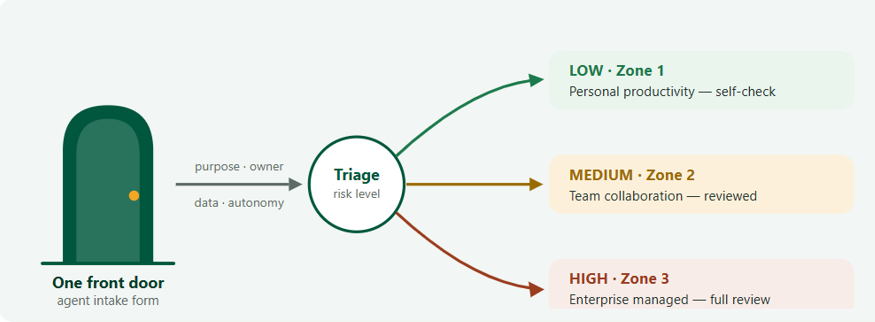
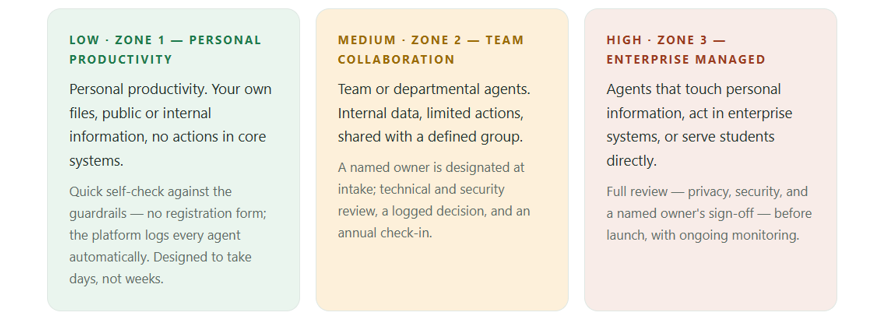
Behind the scenes, each tier corresponds to a platform zone —
- Zone 1 (personal productivity)
- Zone 2 (team collaboration)
- Zone 3 (enterprise managed).
A zone is a managed environment whose permissions, connectors, and sharing controls are set to match that level of risk, so an approved agent operates inside boundaries that actually fit its tier. And accountability never lapses: a Zone 1 agent runs under its maker’s own identity and isn’t shared — you are its named owner by default, and it can only access what you can access. Formal owner sign-off begins at Zone 2, the moment an agent is shared.
Learning at the right level
Governance only works when people know what it asks of them. Working with Microsoft, the AI & Automation team designed and delivered tailored sessions in June for those with the highest access first — a train-the-leader approach: every trained leader becomes a multiplier, carrying good practices into their own team, in their own context. It’s how safe use scales — person to person, not policy memo to inbox.
- End Users — Responsible day-to-day Copilot use: what it can and cannot access, protecting sensitive information, good habits for prompts and outputs.
- Power Users — An introduction to agent capabilities, practical use cases, and best practices for building and using agents securely.
- Administrators — A deep dive into governing agents — access controls, data security, compliance, monitoring, and the guardrails for deploying at scale.
Broader AI literacy for the whole TRU community continues in parallel through the HORAIZON initiative.
Alongside Safe Start
AI agent governance stands on its own — and it works hand-in-hand with the Safe Start Framework, which continues to guide everyday AI use:
- Safety guardrails — the non-negotiables for safe AI use
- Proper Use guidelines — institution-wide guidance in plain language
- Escalation & incident reporting — clear steps and contacts if something goes wrong
- AI Tools PIA guidance — connecting AI adoption to privacy review
Suggested tools & the Copilot-First standard — approved, secure starting points
What happens next
This is the proposed plan, and we are working on establishing these things. Sharing it at this stage is deliberate: at TRU, governance is built in the open, and this page is where the community sees it take shape.
Turning a proposed plan into practice takes real groundwork: confirming ownership across areas like privacy, security, policy, records, and teaching and learning; building the intake pathway; configuring the platform; and putting cost and capacity management in place. Each piece will be built and maintained by the team that owns it, because the best guidance comes from the people who do the work.
Watch this page. As decisions are made and pieces go live, you’ll read about them here first — openly, and in plain language.
Signal of success: the question changes from “Can I build an agent?” to “What’s the best way to build this agent safely?”

Thinking about building an agent, or have ideas on the plan?
We’d love to hear from you — horaizon+safestart@tru.ca